
Town of Rye Resident Lookup Coverage
A careful Town of Rye resident lookup begins by deciding what needs confirmation. The Town assessment record can connect a name to a parcel, while court products can identify a case reference and a vital-record route can document an event. Those are different kinds of evidence. The Town is also a noncontiguous geography made up of Port Chester, Rye Brook, and the Rye Neck portion of Mamaroneck, so a result bearing a nearby place label needs a jurisdiction check before it is treated as a Town record.
| Record | What It Can Confirm | Official Route | Access Boundary |
|---|---|---|---|
| Parcel record | Owner, property address, SBL, mailing address, and assessment facts | Town of Rye PROS | Public search, but owner or mailing address is not occupancy proof |
| Court docket | Case reference, court, party name, calendar or disposition details when displayed | NY Courts eCourts | Online display is not a complete court file |
| Vital record | A birth, death, marriage, or divorce event and relationships allowed by law | New York vital records | Current certified copies are relationship- and ID-restricted |
| Historic news | Dated local notices, obituaries, and community references | Port Chester Journal archive | Historical context, not a current-address roll |
| Professional record | Credential, status, and an official location field | NYSED verification | Location is an identification clue, not a residence |
Begin with the strongest fact already in hand. An address or SBL makes the property route practical; a case number belongs with the court clerk; an event date belongs with the vital-record custodian. A name alone is weakest when it is common. Compare spelling variants, middle initials, past surnames, dates, municipality, and a second independent record before deciding that two results identify the same person.
Town of Rye Property Lookup
The PROS Property Data Search accepts a street address, Tax Map number or SBL, owner name, and a Street Finder selection. Address text is treated as a contains search, and the Town documents an exact-last-name convention using an equals sign before the surname. Road browsing can be safer than guessing a suffix. The resulting property trail is valuable for a resident lookup because it supplies a stable parcel identifier that can be carried into tax maps and deed research.
Read the return as a parcel record, not a household roster. The Town describes location, owner and mailing-address evidence, inventory, exemptions, assessment value, historic cards, photos, tax maps, GIS, and aerial-map links. An owner may be a nonresident, entity, estate, or mailing agent. Neither the owner field nor the mailing address says who occupies a location. For questions about other addresses along a road, use the Town of Rye street directory approach after the initial name check.
| Search keys | Street address, SBL or tax map number, owner name, and Street Finder |
|---|---|
| Useful return fields | Parcel or location, owner, mailing address, assessment data, exemptions, historic cards, photos, and map links |
| Best next check | Compare the SBL and legal description with a Westchester County deed record |
Note: A Town property card reflects assessor information and is not a legal determination or a statement of current occupancy.
Town of Rye Court Lookup
The Town of Rye Justice Court serves the Town geography, not the independent City of Rye. Its published page provides a clerk route, certificate-of-disposition forms for defendants and non-defendants, a small-claims application, sessions, and payment links. It does not provide a public Town party-name search. For a Town matter, the clerk is the evidence route, rather than an assumption that an unreturned web search means there is no case.
NY Courts eCourts coverage guidance identifies WebCivil Local, WebCivil Supreme, WebCriminal, and WebFamily as separate products. Search the product that matches the court and claim before interpreting a name result. The court warns that sealed cases, youthful-offender matters, Article 81 matters, cases without a future appearance, and pending entries can be absent. Even a visible docket is a summary, not the complete file. Confirm a match with its court, case or index number, case type, dates, and disposition, then ask the clerk about the file or certificate.
The Town Justice Court page identifies the clerk at 350 North Main Street in Port Chester, with weekday hours of 8:30 a.m. to 4 p.m. and no entry after 3:30 p.m. Its published phone is (914) 939-3305. That contact path is appropriate for forms, access questions, and correction procedure.
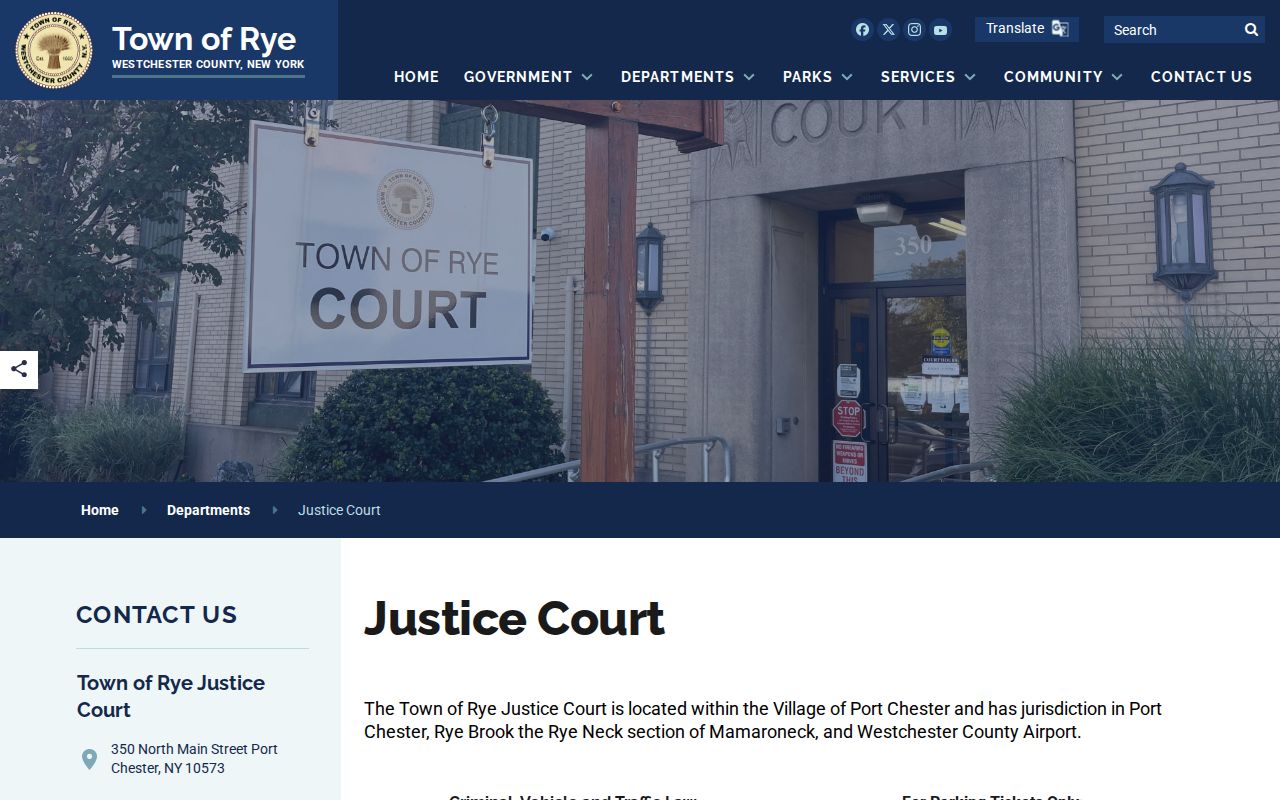
The court page is useful because it shows the clerk and form route that remain available when a public name-search interface is not.
Town of Rye Vital Lookup Routes
Vital research must go to the registrar for the event, not merely to the Town named in an address. The Town Clerk says it holds a local inventory reaching back to 1847, but births and deaths occurring in the Village of Port Chester are obtained from the Village Clerk. Town marriage licenses follow the issuing clerk, and a Rye Neck event requires checking the event municipality and the Village of Mamaroneck or New York State Department of Health route. This split prevents an order from being sent to the wrong custodian.
The NYSDOH genealogy program allows a genealogy search for a birth record at least 75 years old when the person is known to be deceased, and for death or marriage records at least 50 years old, subject to the program's conditions. Direct-line descendants may have exceptions when they provide the required proof. That program is different from a certified copy. Certified copies have relationship and identification requirements, and the appropriate local registrar or NYSDOH decides eligibility.
NYSDOH genealogy guidance lays out the age-based research route and the documentation boundary before an application is submitted.
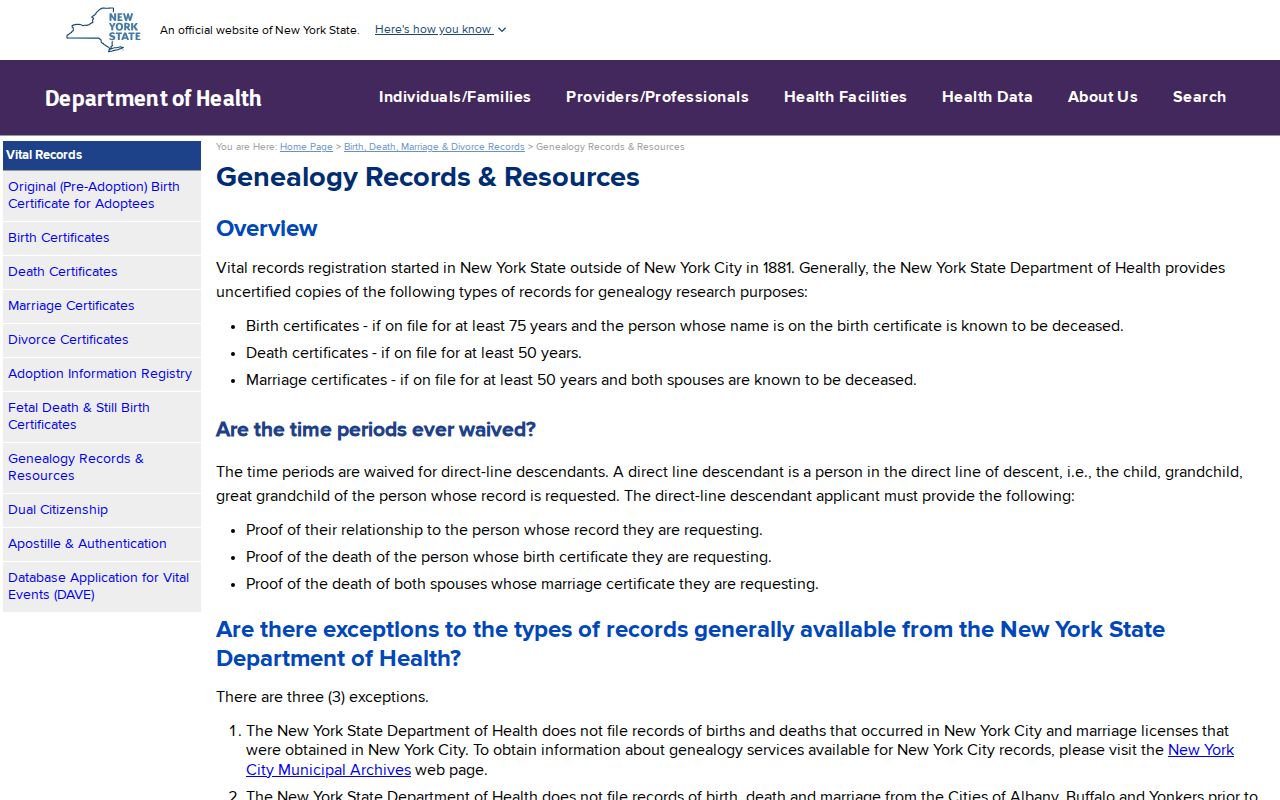
A genealogy result can place a family event in time, but it should not be used to bypass certified-copy restrictions or protected information.
Town of Rye Verification Sequence
A good match needs several anchors. Use a full or variant name, a date range, a Town or village label, and an address or SBL when available. A spouse, relative, professional field, newspaper date, or court case type can supply a further check. Do not combine fragments just because they resemble each other. A court hit for the wrong municipality or an owner record with a different mailing address is a reason to pause, not a reason to fill a gap by guesswork.
- Search PROS by owner, address, or SBL and write down the parcel identifier, property address, and date of the record used.
- Compare the name against a second source that answers a different question, such as a dated Journal notice, a court product, or a vital-record route.
- For a court result, match the court, case or index number, case type, and date before seeking a clerk confirmation or certificate of disposition.
- For an event record, contact the correct registrar and request only the record type for which the applicant is eligible.
- Docket
- A court's running case record, usually showing case identifiers, parties, events, or appearances. It is not necessarily the full file.
- Index and image
- An index helps locate a record by a name, number, or date. An image is the underlying document and may have separate registration, fee, or access rules.
- Certified copy
- A copy issued by the custodian with official certification. New York vital-record eligibility depends on the record and the applicant's relationship and identification.
Note: Treat a conflicting name, date, municipality, or parcel reference as an unresolved mismatch rather than a completed identification.
Port Chester Journal Trail
For historical names, the Port Chester Journal archive is the documented local path. Its digitized Journal run covers 1868 through 1911. Search a name with spelling variants, then compare the date and locality against a parcel, vital, or court reference. An obituary, legal notice, sale notice, or community item can supply a date or relationship that makes two similarly named records easier to separate.
The archive is a historical source, not a current directory. Its value is strongest when a resident lookup has reached an older generation or a former Port Chester reference and needs a dated local lead. The Port Chester-Rye Brook Library can also help with local-history and reference questions when a specific year or title is not open in a web index.
Note: Preserve the publication date and page citation with any newspaper finding so another researcher can test the same identification.
Town of Rye License Lookup
NYSED's online professional verification search is a narrow corroboration tool for a regulated professional. Select one profession, then enter at least three surname letters, or enter a full six-digit license number. The instructions say a name search uses the last name, a space, and first name without a comma. Results can identify the name, profession, license number, location, original-license date, registration status, and disciplinary summaries from January 1994 onward.
A license location is not a home address. It can distinguish people with the same name or support a dated affiliation, but it does not establish that someone lives in Town of Rye. Computerized records from before the mid-1980s can be incomplete, so an older absence deserves a historical or custodian follow-up instead of a conclusion.
The NYSED verification instructions show the profession and name-or-number route used to make that limited comparison.
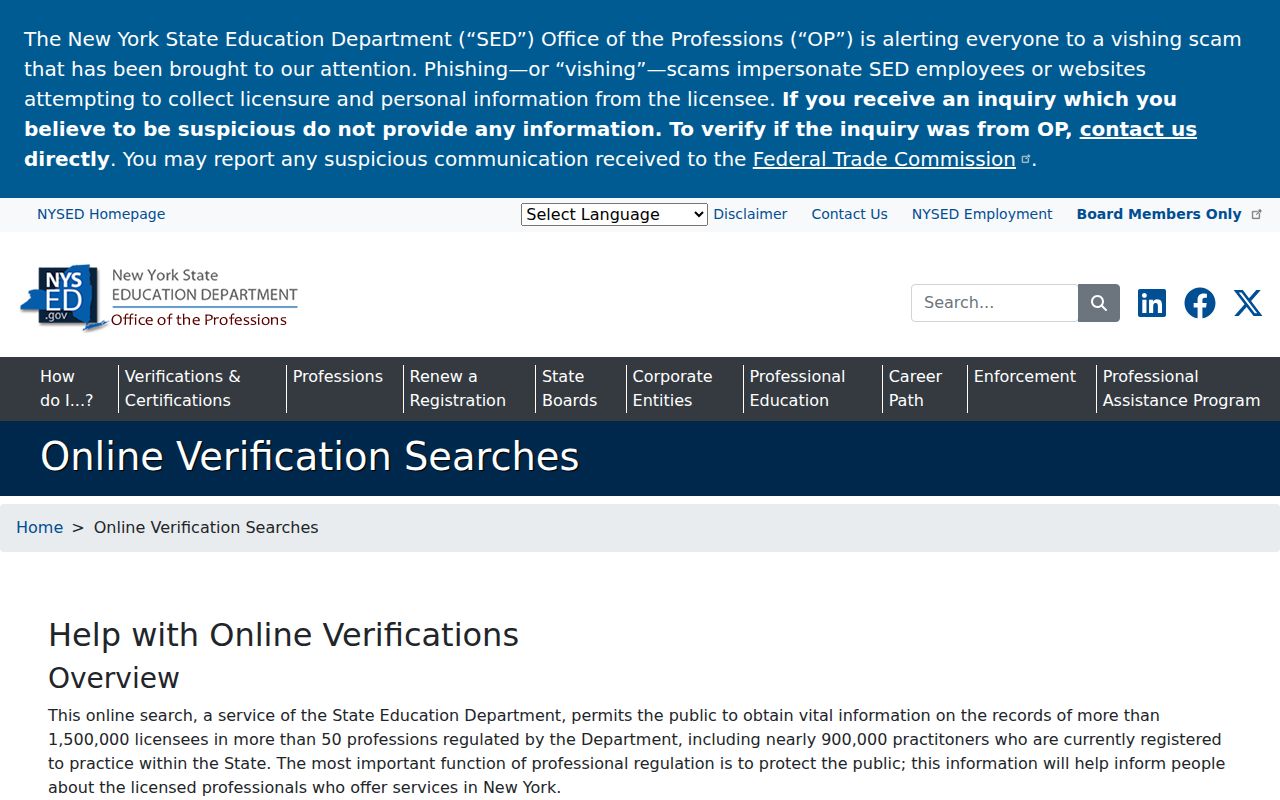
The screen supports a credential check, while the separate parcel and vital-record routes address ownership and family events.
Town of Rye Entity Context
The New York Department of State entity search can help confirm a business affiliation or distinguish an entity from a similarly named individual. It covers entities such as corporations, LLCs, limited partnerships, and LLPs, with fields that can include name, organization date, jurisdiction, county, service address, registered agent, and status. Use it to label an affiliation accurately.
Do not translate a service address, principal location, or registered-agent result into a personal residence. The Department of State record is about the entity and its filing relationship. Older inactive records may also be incomplete. When the question is a person's Town connection, keep the entity result separate from property, vital, and court evidence.
Town of Rye FOIL Requests
When no public index is available, the fallback is a focused request to the custodian. New York's Freedom of Information Law is Public Officers Law Article 6, sections 84 through 90. It provides a route to existing, reasonably described agency records. A useful request identifies the office, record type, address or case number, date range, and preferred format. It does not require the Town to create a resident list or answer an open-ended research question.
The Town FOIL procedure and its online form route describe the local path. Town guidance calls for acknowledgment within five business days and an expected response or estimate within 20 business days, subject to lawful exceptions and fees. For a court file, use the court clerk instead, because court-file access follows its own rules. A precise request for an existing permit folder, certificate, or dated Town record is more usable than a request for every record about a person.
Note: Naming an existing record and a limited time span helps the custodian locate material without creating a new compilation.
Town of Rye Resident Lookup Boundaries
Some correct results are intentionally unavailable. New York's Address Confidentiality Program supplies a substitute address for eligible participants and is not a way to uncover a confidential residence. Confidential voter registration can also protect qualifying records. Court matters may be sealed or restricted, voter information has protected fields and purpose limits, and current vital certificates have eligibility rules. Ask the original custodian about a correction or redaction instead of copying a sensitive record into a personal file.
Lawful personal use. Use a Town of Rye resident lookup for a legitimate personal, family-history, estate, or record-verification purpose. Using addresses or records to pursue, threaten, stalk, or harass anyone can violate New York Penal Law §120.45 and §240.25.
Keep the minimum useful notes: source, date, identifying detail, and reason for the match. A privacy boundary or an uncertain same-name result is part of the record, not a defect to work around.